Skip to content

Deliver the network performance your AI hardware was built for

Cornelis unlocks application performance at any scale by solving one of computing's greatest efficiency challenges. As the only open fabric architecture that spans scale-up and scale-out, Cornelis turns the network from a passive transport into an active compute layer that drives faster AI and HPC outcomes.

  • Request a design consult Arrow - Right
  • NEWS

    Cornelis and NEC expand their collaboration on AI and HPC infrastructure in Japan.

  • Read the announcement Arrow - Right
  • TRUSTED BY NATIONAL LABORATORIES, ENTERPRISE HPC AND AI CENTERS, OEMs AND COMPUTE PARTNERS.

    • AMD logo
    • Atipa logo
    • CIQ logo
    • Dell logo
    • Fusion logo
    • Intel logo
    • Lenovo logo
    • Next Silicon logo
    • Supermicro logo

    An intelligent network knows what runs on it

  • Explore the fabric Arrow - Right
  • From moving data, to accelerating it, to computing on it: each level builds on the last.

    An active compute fabric is an AI and HPC interconnect that acts on and carries the workload. By adding distributed compute at every hop, congestion control and collectives can run in the network instead of on accelerators. One open architecture, across scale-up and scale-out.

    An active compute fabric is an AI and HPC interconnect that acts on and carries the workload.

    Cornelis continues to push fabric boundaries

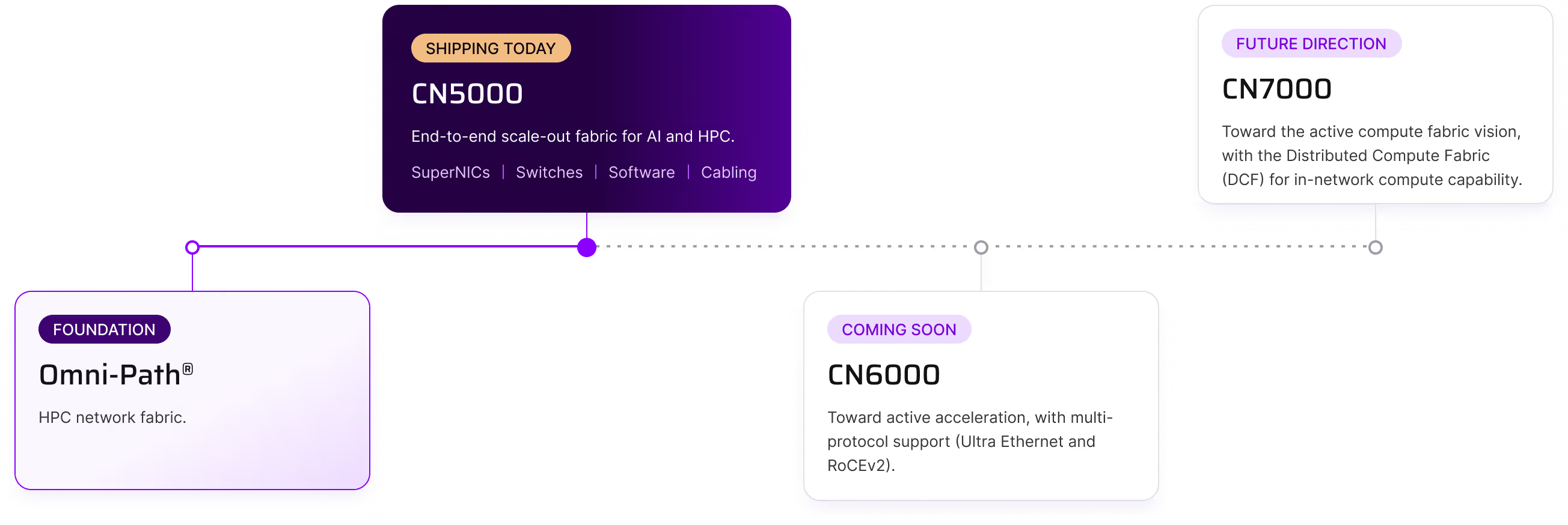
    From the Omni-Path® architecture spun out of Intel to CN5000 shipping today, Cornelis Networks builds on decades of interconnect engineering. Customers have trusted the people behind this work across generations of demanding AI and HPC systems, and Cornelis is now pushing the fabric toward active compute.

    Built by engineers with decades of interconnect experience. Trusted by customers running demanding AI and HPC workloads.

    Connect the fabric

    SuperNICs, Switches and Director Class switches, cabling and open software in one architecture. Cornelis designs every layer, from silicon through software, and tunes the full fabric as one system.

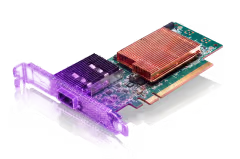
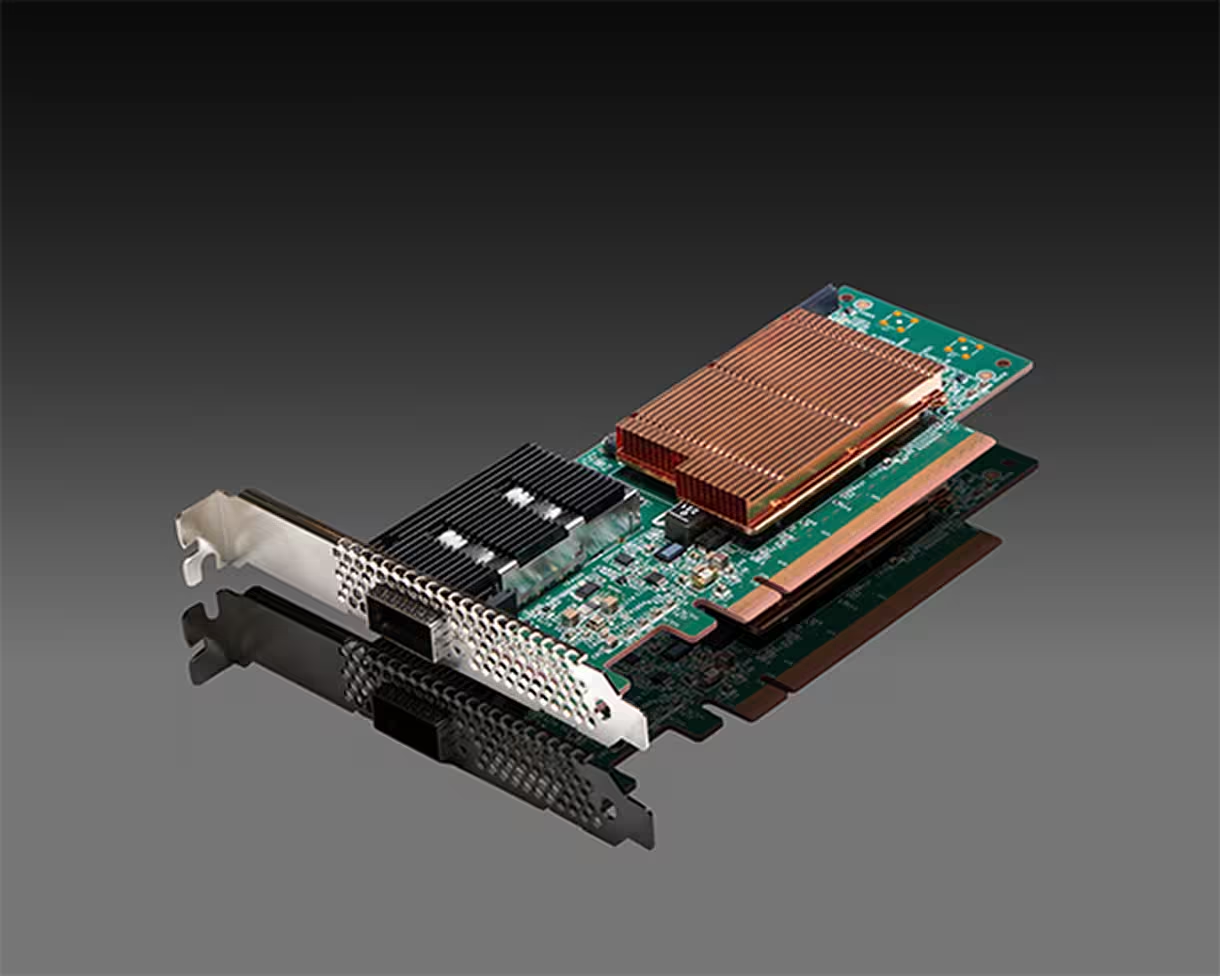
    SuperNICs

    One or two 400 Gb/s ports on a low profile x16 PCIe Gen 5 adapter.

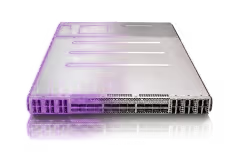
    Switches

    48 ports at 400 Gb/s for 38.4 Tb/s full duplex, air or liquid cooled.

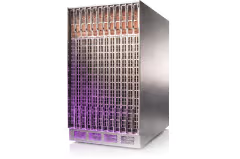
    Director class switches

    576 ports at 400 Gb/s, up to 230.4 Tb/s, two tier fat tree in one chassis.

    Cables

    Passive copper, active copper and active optical, at 400 Gb/s per link.

    OPX Software

    Open source software from host drivers to fabric and switch management, built on libfabric. MPI, OpenSHMEM, and RCCL applications run without code changes.

    Designed for both HPC and AI workloads

    • >2X*higher message rates than comparable 400 Gb/s solutions.
    • +30%*lower latency than InfiniBand.
    • 30%better performance per networking dollar, maximizing ROI.

    *Compared with NDR InfiniBand, based on an internal Cornelis benchmarking study. Contact Cornelis for more information.

    Community recognition

    Cornelis has been named best interconnect by the the field's trade press, and its fabric runs in national laboratories.

    HPCwire Readers' Choice and Editors' Choice

    Best HPC Interconnect Product or Technology, for the Cornelis CN5000 Omni-Path product family.

  • View the award Arrow - Right
  • HPCwire Editors' Choice

    Top 5 New Products or Technologies to Watch, for Omni-Path Express and Omni-Path, in two consecutive years.

  • View the award Arrow - Right
  • CRN 10 Hottest Semiconductor Startups

    Named to CRN's list of the hottest semiconductor startups, twice in the same year.

  • View the list Arrow - Right
  • TOP500 CTS-2 systems

    Cornelis Omni-Path carries the CTS-2 systems at Lawrence Livermore and Sandia on the TOP500.

  • View the list Arrow - Right
  • IO500 ISC24 ten node list

    The NHR@ZIB Lise system placed third on the IO500 ISC24 ten node production list.

  • View the list Arrow - Right
  • Frequently asked questions

    What the fabric is, why clusters underperform, how it differs from Ethernet and InfiniBand, and where it runs today.

    • What is Cornelis Networks? Cornelis Networks is a networking company that builds the active compute fabric, an open interconnect for AI and HPC clusters. Cornelis ships the CN5000 Omni-Path family of SuperNICs, Switches, Director Class Switches, and the OPX software stack, as an alternative to InfiniBand and Ethernet fabrics.
    • What is an active compute fabric? An active compute fabric is an AI and HPC interconnect that runs computation inside the network rather than only transporting packets across it. A passive fabric moves bytes and leaves every collective, reduction and cache operation to the accelerators. An active fabric performs part of that work at the port, on the data in flight.
    • Why do GPUs sit idle in large AI and HPC clusters? AI performance is increasingly limited by the network, not the accelerators. As clusters scale, accelerators spend more time waiting on congestion, synchronization, and long-tail latency. Simply adding bandwidth cannot solve these inefficiencies. An active compute fabric removes them at the source with lossless credit-based flow control, intelligent real-time routing around hotspots, and built-in collective acceleration that delivers up to 6× faster collective performance than RoCE, keeping accelerators focused on AI, not communication.
    • What workloads does Cornelis support? Cornelis is built for AI and HPC workloads where many processors must exchange data quickly and predictably. For AI, that includes distributed training and inference, along with communication-heavy workloads such as collective operations, mixture-of-experts, and disaggregated serving. For HPC, it includes tightly coupled applications such as computational fluid dynamics, climate modeling, molecular dynamics, seismic imaging, and other MPI-based workloads. These workloads depend on more than peak bandwidth. Message rate, latency, congestion behavior, collective efficiency, and time to solution all affect application performance. Cornelis provides a shipping fabric foundation for these workloads today, while its Active Compute Fabric vision moves more communication and computation into the network.
    • How does an active compute fabric compare with Ethernet, RoCE and InfiniBand?

      An active compute fabric is designed to work with the Ethernet ecosystem rather than replace it. Ethernet provides a broad networking foundation, RoCE carries RDMA traffic over Ethernet, and InfiniBand is purpose-built for AI and HPC. Cornelis adds capabilities such as lossless credit-based flow control, adaptive routing, congestion control, telemetry, and workload-focused acceleration.

      CN5000 is the shipping scale-out foundation for this direction. CN6000 is positioned to extend the architecture toward broader protocol interoperability, including an Ultra Ethernet compliant software and provider path, subject to supported configurations. Applications do not need rewrites solely to adopt the architecture, but each deployment should be validated against supported hardware, protocols, providers, software versions, and workloads.

    • Which accelerators and infrastructure does Cornelis work with? Accelerator choice stays with you. Cornelis attaches to the accelerators, storage and schedulers already in the cluster, and applications built on MPI, OpenSHMEM and RCCL run without code changes. At the scale-up layer, where proprietary interconnects lock accelerator choice for the life of a deployment, the CN7000 design target is native UALink support across AMD, Intel and NVIDIA accelerators, giving one open architecture across scale-up and scale-out.
    • What is open standard networking? Open standard networking means the interfaces, protocols and management models a fabric runs on are published and governed in the open, so more than one vendor can implement them and buyers are not locked to a single supplier. Cornelis contributes to libfabric, the OpenFabrics Interfaces project the Ultra Ethernet Consortium has adopted, and participates in UALink. MPI, OpenSHMEM and RCCL applications run without code changes, and management uses OpenBMC and Redfish. Open standards are a commitment, not a talking point.
    • Is Cornelis proven in production? CN5000 is shipping today, built on the Omni-Path architecture and its production heritage in high performance computing, and validated at national laboratory scale. Omni-Path carries the CTS-2 systems at Lawrence Livermore and Sandia on the TOP500. OEM partners qualify it in their own systems: Lenovo's validation on ThinkSystem SC750 V4 with Intel Xeon 6 measured 378 to 391 Gb/s across node pairs, averaging 385 Gb/s, at approximately 1.1 microseconds node to node.
    • What is Cornelis Networks' connection to Intel? Cornelis Networks grew from the spinout of Intel's high-performance interconnect business. The company continued the Omni-Path® technology lineage with an experienced team focused on the demands of AI and HPC. Customers get a shipping fabric built on a proven foundation, along with a clear path toward the next generation of active compute.
    • How does Cornelis work with strategic partners? Cornelis delivers and sells its fabric solutions through a strategic partner ecosystem. Partners help customers bring together the technology, integration, and expertise needed for AI and HPC environments, while Cornelis keeps the fabric open to the systems and infrastructure choices that fit each deployment.

    Latest News

    Cornelis and NEC Corporation Expand Collaboration to Advance AI and HPC Infrastructure in Japan

    An expanded collaboration covering AI and HPC infrastructure in the Japanese market.

  • Read the article Arrow - Right
  • Beyond the Benchmark: How OEM-Validated AI and HPC Fabrics Reduce Deployment Risk

    What OEM validation adds on top of a benchmark sheet, and why it matters before a fabric reaches your data centre.

  • Read the article Arrow - Right
  • Get More from Your 400 Gb/s Fabric: Lessons from Lenovo’s Cornelis CN5000 Validation

    When you invest in a 400 Gb/s fabric, the gap between “installed” and “optimized” is measured in real money.

  • Read the article Arrow - Right
  • Bring us the cluster you already own.

    We size an active fabric against your real topology, accelerators, and workload mix.

  • Request a design consult Arrow - Right