Cornelis CN6000
Performance where it matters.
Flexibility where you need it.
Performance where it matters.
Flexibility where you need it.
AI and HPC returns depend on keeping expensive accelerators busy. Cornelis® CN6000™ is the industry’s first 800G SuperNIC family that includes both Omni-Path® and Ethernet connectivity options, so you can choose the fabric that fits your workload and network.
The CN6000 Omni-Path SuperNIC delivers 1.6 billion messages per second and sub-microsecond MPI latency on a lossless fabric that scales past 500,000 endpoints.¹ Paired with the 48-port CN6000 Omni-Path Switch, it helps training runs and simulations finish sooner. Applications carry forward from CN5000 to CN6000 and on to CN7000 with a fully compatible software stack.
For Ethernet-first AI, the CN6000 Ethernet SuperNIC brings standards-based RoCEv2 to fine-tuning and inference, and it is Ultra Ethernet compliant (Preview). Its lightweight queue pairs handle the bursty inter-GPU traffic of distributed fine-tuning.
More work from every XPU: 1.6 billion messages per second and 800 Gb/s per Omni-Path SuperNIC cut the time accelerators spend waiting on the network.
Bigger fabrics, smaller fault domains: Two independent 400 Gb/s data paths, matched by a dual-plane 800G switch, support multi-plane and multi-rail designs.
Serve more tokens and accelerate fine-tuning: The Omni-Path SuperNIC moves disaggregated inference traffic with sub-microsecond latency. The Ethernet SuperNIC brings RoCEv2 to fine-tuning and inference on standards-based switches and is Ultra Ethernet compliant (Preview).
CN6000 at a glance: four headline figures for the Omni-Path and Ethernet SuperNICs.
¹ Results vary with configuration, workload and topology.
Accelerators are the largest line item in an AI or HPC cluster. CN6000 helps you get more from each one, grow the fabric safely, and serve inference on the network you choose.

Faster time to results and higher accelerator utilization
Collectives, small messages and sync stalls leave GPUs idle. The CN6000 Omni-Path SuperNIC pairs the industry's highest message rate with 800 Gb/s of bandwidth. Communication keeps pace with compute, so training runs and simulations finish sooner.

800G multi-plane and multi-rail designs that scale and keep jobs running
Two independent 400 Gb/s data paths let each node connect to two switch planes. You get up to 800 Gb/s per node while each plane keeps the radix and low hop count of a 400G fabric. A fault in one plane stays in that plane, so long jobs keep running.
Omni-Path or RoCEv2 for inference; RoCEv2 for fine-tuning on Ethernet
KV cache handoffs and attention-FFN exchanges sit on the critical path of disaggregated inference. The CN6000 Omni-Path SuperNIC moves that traffic with sub-microsecond latency, which helps lower time to first token and cost per token. For Ethernet-first teams, the CN6000 Ethernet SuperNIC brings RoCEv2 to inference and fine-tuning on standard switches.
Faster switch ports usually cost you radix, which adds tiers, hops, optics and cost as clusters grow. A single plane is also a single failure domain. CN6000 takes a different path.
Each CN6000 Omni-Path SuperNIC port carries two independent 400 Gb/s links. The CN6000 Omni-Path Switch is built the same way, with two independent 48-port 400G planes in one 1U switch. With one straight cable, every node lands on both planes at up to 800 Gb/s, while each plane stays a 400G fabric with full radix and a low hop count.
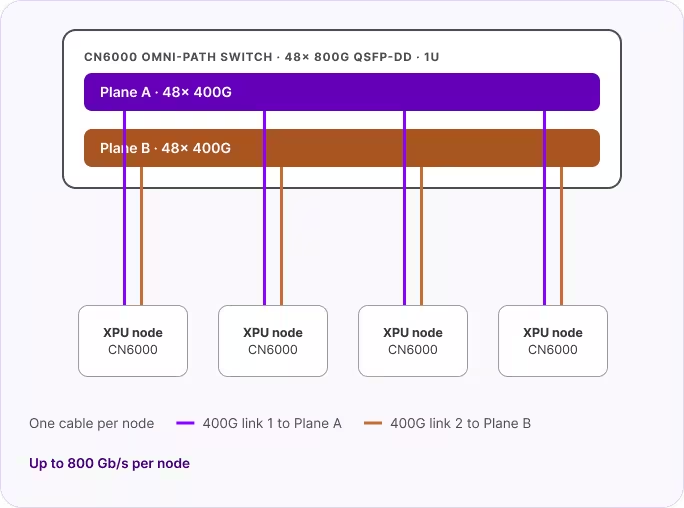
The OPX libfabric provider drives both data paths at once, so one job can use the full bandwidth of both planes.
A switch, link or optics failure in one plane leaves the other plane running, so the cluster keeps working while you service it.
Connect GPU number n in every node to rail n, so collectives between same-index GPUs stay on one rail.
Each plane keeps 400G switch radix and a low hop count, so large clusters need fewer tiers, hops and optics.
Put compute on one plane and storage or checkpoint on the other, so they stop competing for the same paths.
CN6000 SuperNICs also drop into existing CN5000 switching, so your teams grow bandwidth without learning a new protocol.
CN6000 comes as two SuperNICs, each built for the fabric you choose. The Omni-Path SuperNIC pairs with the CN6000 Omni-Path Switch for an end-to-end Omni-Path fabric. The Ethernet SuperNIC connects to standards-based Ethernet switches. OPX software runs the Omni-Path fabric.
For HPC and performance-intensive AI, including disaggregated inference. The Omni-Path SuperNIC and the CN6000 Omni-Path Switch form an end-to-end 800G fabric, natively designed for multi-plane, and OPX software runs it.
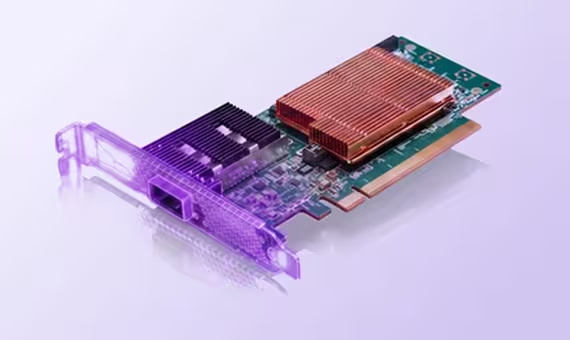
The CN6000 Omni-Path SuperNIC delivers 800 Gb/s over two independent 400 Gb/s data paths on a low-profile PCIe 6.0 x16 adapter. Credit-based flow control, link-level retry and fine-grained adaptive routing keep the fabric lossless as it grows past 500,000 endpoints. Sub-microsecond MPI latency helps large-scale AI training and HPC codes finish sooner.
Learn more about the Omni-Path SuperNIC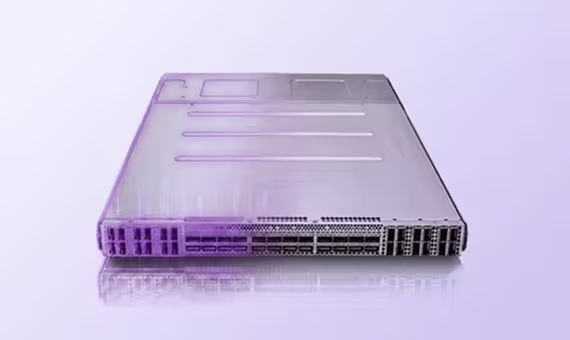
The CN6000 Switch delivers 48 ports of 800 Gb/s connectivity, or 96 ports at 400 Gb/s, in a 1U liquid-cooled platform. It is natively designed for multi-plane fabrics: two independent 400G planes let one cable per node reach both. Fine-grained adaptive routing, credit-based flow control and switch latency as low as 105 ns keep AI and HPC traffic moving under load.
Learn more about the Omni-Path Switch
Cornelis OPX is an open software stack that spans host drivers, fabric services and switch management. The OPX libfabric provider drives both data paths for up to 800 Gb/s per node with multi-rail, and it uses the same provider and host driver as CN5000, so both generations share one fabric. MPI, OpenSHMEM, NCCL and RCCL run unchanged.
Learn more about OPXFor Ethernet-first AI, including fine-tuning and inference on Ethernet networks. The Ethernet SuperNIC connects to the standards-based Ethernet switches you choose.
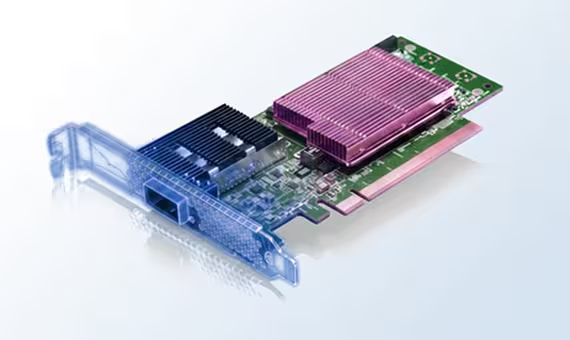
The CN6000 Ethernet SuperNIC brings hardware-accelerated RoCEv2 to standards-based Ethernet switches and is Ultra Ethernet compliant (Preview). Lightweight queue pairs and an RiF table that tracks millions of in-flight operations handle the many small transfers of inference and the bursty traffic of fine-tuning. Priority Flow Control with 8 priorities keeps traffic lossless, and IEEE 1588 PTP fits the Ethernet network you already run.
Learn more about the Ethernet SuperNICCN6000 carries the proven Omni-Path architecture into a new generation. Six advances shape what it can do for your cluster.

Each SuperNIC moves 800 Gb/s over a PCIe 6.0 x16 host interface, twice the bandwidth of the previous generation. Nodes keep pace with faster accelerators.

Two 400 Gb/s paths can each reach their own switch plane, and the CN6000 Switch carries two independent planes in one 1U box. That enables multi-plane and multi-rail designs, and it contains a fault to one plane.

Optimized send and receive buffer management drives 1.6 billion messages per second on the Omni-Path SuperNIC. MPI, SHMEM and collectives spend less time on the wire.
A new Ethernet adaptation layer brings Omni-Path design to an Ethernet SuperNIC. Choose the Omni-Path SuperNIC for HPC and performance-intensive AI, or the Ethernet SuperNIC for Ethernet-first AI.
Hardware-driven RDMA, lightweight queue pairs and an in-flight tracking table handle the many small transfers of disaggregated inference and the bursty traffic of fine-tuning.
A Root of Trust secured with post-quantum cryptography supports SPDM 1.4 with ML-DSA-87 and ECDSA P-384. Firmware and identity stay protected as threats evolve.
Silicon and systems partners see CN6000 as a way to raise performance, scale out, and bring standards-based Ethernet to AI and HPC.
GET MORE FROM EVERY XPU
"As our compute footprint has grown, maintaining high utilization across our accelerators has become critical. The CN6000 promises to provide the consistent, low-latency fabric necessary to keep our training and simulation workloads running efficiently into the 800G infrastructure upgrade cycle."
Alex Lesser
Vice President, Sales and Marketing, PSSC Labs
BUILD BIGGER, MORE RESILIENT FABRICS
"We believe open, standards-based innovation is key to unlocking scalable, high-performance infrastructure for the future of AI and HPC. Industry collaborations like the Ultra Ethernet Consortium help ensure a diverse and interoperable ecosystem, empowering customers with choice and flexibility to meet evolving compute demands."
Robert Hormuth
Corporate Vice President, Architecture and Strategy, AMD
SERVE MORE TOKENS ON STANDARD ETHERNET
"Lenovo is focused on building HPC and AI-optimized systems that scale. We expect Ultra Ethernet to be transformative for the AI market, and are looking forward to the CN6000 and enabling our customers who want no-compromise high performance with Ethernet-based infrastructures."
Scott Tease
VP and GM, HPC and AI, Lenovo
Source: Cornelis CN6000 launch announcement, November 18, 2025
Omni-Path runs in production at Lawrence Livermore National Laboratory on the Lynx system and at the Texas Advanced Computing Center on Stampede3, both with CN5000. CN6000 brings the same fabric to 800G with support from server, silicon, software and channel partners. The logo grid below lists those partners.












A validated design that pairs CN6000 with AMD EPYC (Venice) processors and AMD Instinct MI400 series accelerators.
Server OEMs and channel partners sell CN6000 in configured systems. Pricing depends on your configuration, so there is no single list price.
OEMs and system integrators deliver CN6000 as part of configured AI and HPC systems. Federal buyers can work through approved integrators.
Scale: Node count and endpoint targets.
SuperNIC: Omni-Path SuperNIC or Ethernet SuperNIC.
Fabric design: Single plane, or multi-plane and multi-rail.
Switching: CN6000 Switch, existing CN5000 switching, or third-party Ethernet switches.
Cooling: Air or conduction for SuperNICs; liquid for the switch.
Ask Cornelis or a partner for current availability. Lead times vary by configuration.
The lists below give the main SuperNIC and switch specifications. See each product brief for full details.
| Bandwidth | 800 Gb/s; 1.6 Tb/s bidirectional |
|---|---|
| Ports | Dual x4-lane QSFP-DD, 112 Gb/s per lane |
| Host interface | PCIe 6.0 x16 |
| SuperNICs | Omni-Path SuperNIC; Ethernet SuperNIC (RoCEv2; Ultra Ethernet compliant (Preview)) |
| Message rate | 1.6B messages/s, bidirectional (Omni-Path SuperNIC) |
| Latency | Sub-1 µs MPI (Omni-Path SuperNIC) |
| Virtual lanes and MTU | 1 to 4 data VLs plus 1 management VL; MTU 2, 4, 8 or 10 KB per VL (Omni-Path SuperNIC) |
| Security | PQC Root of Trust; SPDM 1.4 (ML-DSA-87, ECDSA P-384) |
| Management | SR-IOV; PLDM, MCTP and Redfish (RDE) |
| Form factor | PCIe low profile, 3.12 x 6.6 in |
| Cooling | Air-cooled or conduction-cooled |
| Typical power | 42.4 W (DAC); 57.5 W (AOC) |
| Bandwidth | 76.8 Tb/s full duplex |
|---|---|
| Ports | 48 x 800G QSFP-DD, or 96 x 400G |
| Architecture | Two independent 48-port 400G planes |
| Routing | Fine-grained adaptive and static dispersive routing |
| Flow control | Credit-based, incast-aware; link-level retransmission |
| Switch latency | As low as 105 ns |
| Virtual lanes | 1 to 8 data VLs plus 1 management VL |
| Security | Secure boot and protected key storage |
| Management | OpenBMC with Redfish and PLDM; in-band and out-of-band; CLI |
| Form factor | 1U; 17.2 x 26.1 in |
| Cooling and power | Liquid-cooled; 240 to 277 VAC or 48 VDC; N+N hot-swap supplies |
| Typical power | 856 W (all DAC); 1,663 W (all AOC) |
Cornelis is moving toward an open fabric that spans Omni-Path and standards-based Ethernet. CN6000 is a step on that path: Cornelis now offers an Ethernet SuperNIC beside the Omni-Path SuperNIC, on open-source software your teams already use.
Built on libfabric: OPX runs on libfabric (OFI), the open interface that Cornelis originally developed. libfabric · Cornelis OPX
Open standards: The Ethernet SuperNIC runs standards-based RoCEv2 and is Ultra Ethernet compliant (Preview), which reflects our commitment to open standards. Ultra Ethernet Consortium
Frameworks you already run: MPI, OpenSHMEM, NCCL, RCCL, UCX and PyTorch.
Any accelerator: GPUDirect for NVIDIA and ROCm RDMA AMD accelerators.
A path forward: CN5000 and CN6000 share one driver, and applications carry forward to CN7000 with a fully compatible software stack.
Operating systems: The Omni-Path SuperNIC runs on the Linux distributions listed on the OPX page. The Ethernet SuperNIC supports Red Hat Enterprise Linux (RHEL), with other distributions on request. OPX page
Everything about the CN5000 fabric in one place — architecture, positioning against InfiniBand and Ethernet, roadmap and procurement.